Tuesday, December 1, 2009

An Outburst For Reasons Unknown


This image from the Hubble Space Telescope shows V838 Mon, the bright red star in the center, and the aftermath of a sudden expansion in size and brightness. In fact, in 2002 when the star had this "outburst for reasons unknown", it suddenly became the brightest star in the Milky Way Galaxy. Then, just as suddenly, it faded. A "stellar flash" like this has never been seen before. Although it seems that this flash has expelled matter into space, the material that you see surrounding V838 Mon in the image is not material at all - it is a "light echo" travelling through the interstellar dust that already existed around the star cluster. The star is located about 20,000 light years away, and the light echo spans nearly 6 light years across.

Friday, October 9, 2009

How far is a light year?

With all this talk about light years, it may help to truly know how far a light year really is. A light year is an astronomical measure of distance. As defined by the International Astronomical Union, a light year is the distance that light travels in a complete vaccuum in one Julian year, which is about 5,878,630,000,000 miles. So many miles is really hard to comprehend, so to put this into perspective, it is about 3300 miles across the United States from Maine to California. If you traveled back and forth across the country until you went as far as light would travel in a year, you would have to drive coast to coast 1,781,403,030 times! Thats right, almost 2 billion times. In terms of the entire world, which has a circumference of 24,901.55 miles at the equator, you would need to circle the entire planet nearly 236,074,863 times! Our sun is about 93,000,000 miles away from the Earth. If we traveled to the sun and back 31,606 times, we would have finally traveled as far as light does in one year. Now that you know how far a light year is, you can begin to grasp how large our galaxy and the Universe really are.

Monday, October 5, 2009

Saturn's Night Side


The Cassini Robotic Spacecraft, now orbiting Saturn, took this image as it made its way into Saturn's shadow. Many new discoveries have been made from this picture. The planet's rings are so brightly illuminated that new rings were found. The outermost ring in the picture is Saturn's E ring, created by ice-fountains on its moon Enceladus, seen here in great detail like never before. Also, the night side of Saturn, a side never before seen, is partially brightened by reflecting light off the rings. Finally, about 746 million miles off in the distance, just above the rings on the left, is the faint light of Earth.

Thursday, October 1, 2009

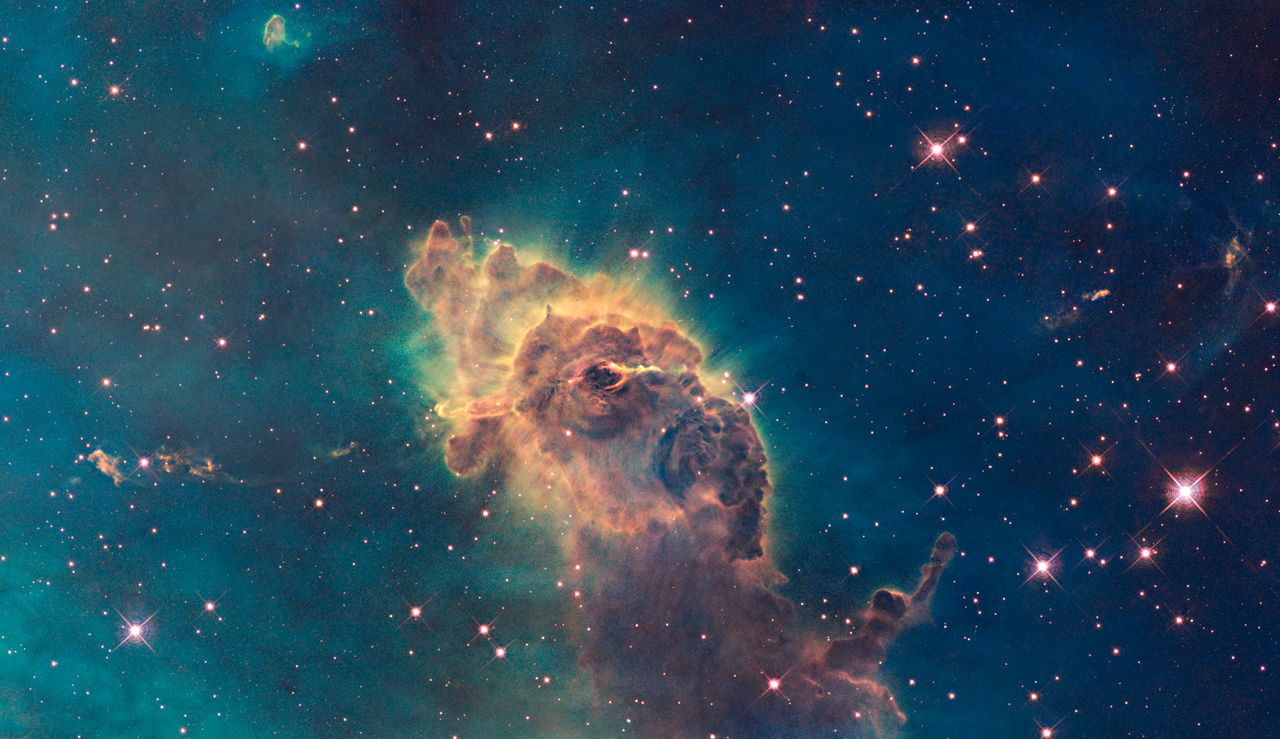
The Carina Pillar and Jets (Infared Light)


This image of the Carina Pillar shows its jets in great detail. The two jets shoot out materials from a young, very hot star nearly 3 lightyears across. Also shown are the newly forming stars that are hidden behind the dust and gas in visible light.

The Carina Pillar and Jets


This pillar of dust and gas is found nearly 7,500 lightyears away. Newly formed stars are still appearing inside this massive pillar, which is estimated to be 2 lightyears wide.

Wednesday, September 30, 2009

The SN 1006 Supernova Remnant


Likely the brightest supernova in recorded human history, the SN 1006 supernova remnant is about 60 light years across. A supernova is caused by the death of a star in two different ways. A gravitational collapse will cause the star to end as a neutron star. In the case of SN 1006, the star acquired too much material from a neighboring star (a stellar companion), causing an uncontrollable nuclear reaction, completely destroying the star. This explosion was first seen in the year 1006 AD. Seeing that the SN 1006 supernova remnant is about 7,000 lightyears away from Earth, the thermonuclear destruction of the star occurred 7,000 years before it was seen in the night sky in the year 1006.

When Galaxies Collide


NGC 7331, the galaxy at the upper right of the picture, is one of the brightest galaxies in the universe. Nearly 50 million lightyears away, it is very similar in size and shape to our own galaxy. In the lower left, Stephan's Quintet is a cluster of five galaxies about 300 million lightyears away, four of which make up the first ever recorded collision of galaxies. The four colliding galaxies are involved in a cosmic dance that will eventually end with them merging into one large galaxy. You would think that many of the stars in these galaxies would collide also, but in fact, the distance between stars in any galaxy (which average between 5-10 lightyears) makes the chances of this happening nearly zero.

M31 Seen in Ultraviolet Wavelengths


The Andromeda Galaxy (a.k.a. M31) is the closest spiral galaxy to the Milky Way, about 2,500,000 lightyears away. Seen here in ultraviolet wavelengths, the bright blue sections of the galaxy are dominated mainly by very hot, young stars and very dense star clusters. M31 is the furthest stellar object visible in the night sky by the naked eye, visible on a moonless night with moderate light pollution. Although it appears nearly six times as wide as the full moon, only the bright central region of the galaxy is visible. In 2006, the Spitzer Space Telescope revealed that M31 contains more than one trillion stars. In comparison, the Milky Way Galaxy only contains between 200 billion to 400 billion stars.

NGC 3621


This is NGC 3621, a galaxy located far outside our "neighborhood" of galaxies, some 22,000,000 lightyears away. The blueish haze that surrounds the galaxy is the furthest outskirts of the galaxy in which millions of stars exist. To travel across NGC 3621 from end to end would take nearly 100,000 lightyears. The brighter stars in the picture that seem to be closer are stars located in our own Milky Way Galaxy, and the stars that seem further away (circled in red) are not stars at all - some are galaxies even more distant than NGC 3621.

Orion's Many Secrets


The constellation known as Orion holds much more than simply 3 stars in a straight line. The three bright blue stars pictured are the stars that make up Orion's Belt. Below the lowest star of Orion's Belt, Alnitak, is the Flame Nebula, which glows with excited hydrogen gas. To its immediate right is the Horsehead Nebula, a dark formation of dense dust in the familiar shape of a horse's head. The formations found in this picture are estimated to be between 1,500-1,600 lightyears away from Earth. It is estimated that it would take approximately 13 lightyears to travel the expanse of the Horsehead Nebula alone.


Monday, September 28, 2009

CoRoT Satellite Discovers Rocky Planet


CoRoT-7b, a newly discovered planet more than 500 light years away, is the closest physical match to Earth scientists have ever found. It's mass is nearly 5 times that of Earth's, and it's radius is estimated at about 1.7 Earths. However, CoRoT-7b is closer to its star than Mercury is to our sun, causing its year to last only 20 hours, and its surface temperature to be much too hot to support life. Astronomers will be observing CoRoT-7b further, hoping to find what composes the first rocky planet discovered outside our solar system.